Neighbors for Clean Air
Neighbors for Clean Air is a community air monitoring project that aims to empower residents with high quality data to make informed decisions about health and guide positive environmental change.
We are a partnership between community scientists, non-profits, and researchers, who will work together to collect, interpret, and share data from a network of air quality sampling devices at resident and community hosted sites across the Greater Midway and Frogtown area.
About the project
How it started
Neighbors for Clean Air began as a grassroots effort to respond to community questions about local air quality, questions that often go unanswered by existing regional monitoring systems. Community leaders identified a need for neighborhood-scale data that reflects real world conditions and advocated for agencies to provide resources
Funding for this work was awarded by the Minnesota Pollution Control Agency (MPCA) to three Twin Cities based projects including Neighbors for Clean Air. Though these projects are not affiliated, they share the common goal of supporting resident informed air monitoring networks in focus areas defined by community priorities.
Why Community Partnership Matters
Community knowledge is essential to understanding environmental health. Scientific measurements alone cannot capture how pollution affects daily life, health concerns, or long-standing inequities.
Neighbors for Clean Air is built on the belief that meaningful research happens with communities, not on them. Project design, monitoring locations, and interpretation of results are informed by residents who live in the areas being studied. This collaborative approach helps ensure the data is relevant, trustworthy, and useful for community-led action.
How It Works
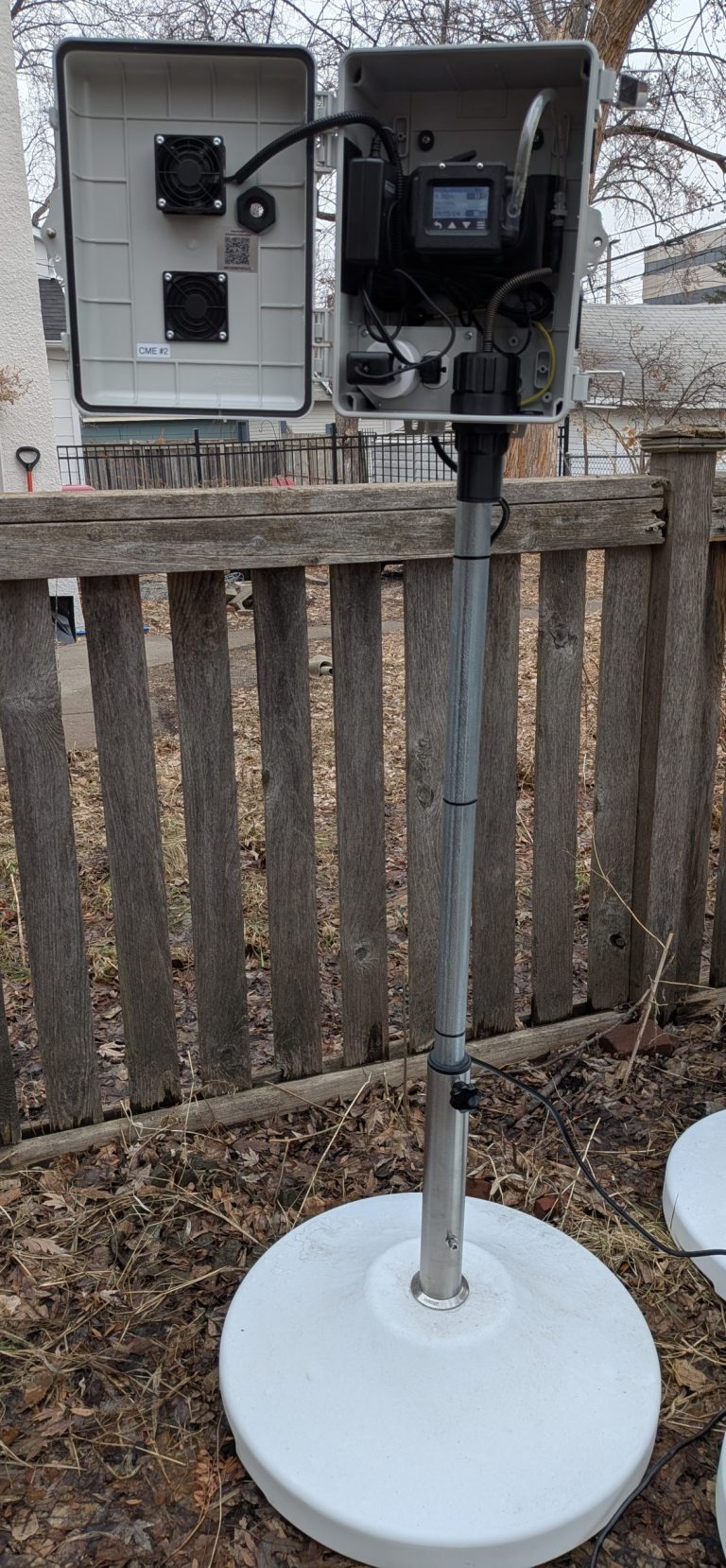
The air monitoring devices used in this project were collaboratively designed by researchers at Minnesota State University, Mankato and the Osluv Project. Devices are hosted at resident and community sites and are designed to collect samples that can be analyzed for heavy metal content in the air.
Each device has a few components including an enclosure to protect from weather, a stand to mount the sample around “breathing height”, a pump that records the volume of air sample, and a filter that collects the particulate matter that will be tested for heavy metals.
The project analyzes air samples for:
- Arsenic (As)
- Barium (Ba)
- Cadmium (Cd)
- Chromium (Cr)
- Copper (Cu)
- Iron (Fe)
- Lead (Pb)
- Zinc (Zn)
Sources of these may include:
- Vehicle brake wear (Barium, Copper, Iron, Zinc)
- Diesel and oil combustion (Arsenic, Barium)
- Industrial metal processing (Arsenic, Copper, Iron, Cadmium, Chromium, Zinc)
Because heavy metals settle out of the air more quickly than many other pollutants, concentrations typically decrease with distance from emission sources. This makes localized monitoring especially important for understanding neighborhood-level exposure.
This approach allows for consistent, monitoring over time at the neighborhood level, helping identify patterns that are not visible through large-scale regional monitoring systems alone.
Data Access & Transparency
Transparency is a core value of this project. All data collected through the project will be publicly available via an interactive online map developed by JustAir, a community air monitoring nonprofit based in Detroit.
To protect participant privacy and site security, exact monitoring locations will not be publicly listed. Instead, data will be referenced using nearby intersections to maintain geographic context without identifying specific addresses.
Public summary reports describing methods and findings will be released at the project midpoint and again at the project’s conclusion in Summer 2027.
Get involved!
- Learn more about air quality
- Apply to host a sampling device
- Stay up to date by signing up for updates through our newsletter
- Check out our calendar to find events and committee meetings!
Project partners
This project would not be possible without funding from the Minnesota Pollution Control Agency as well as support from our partners below.